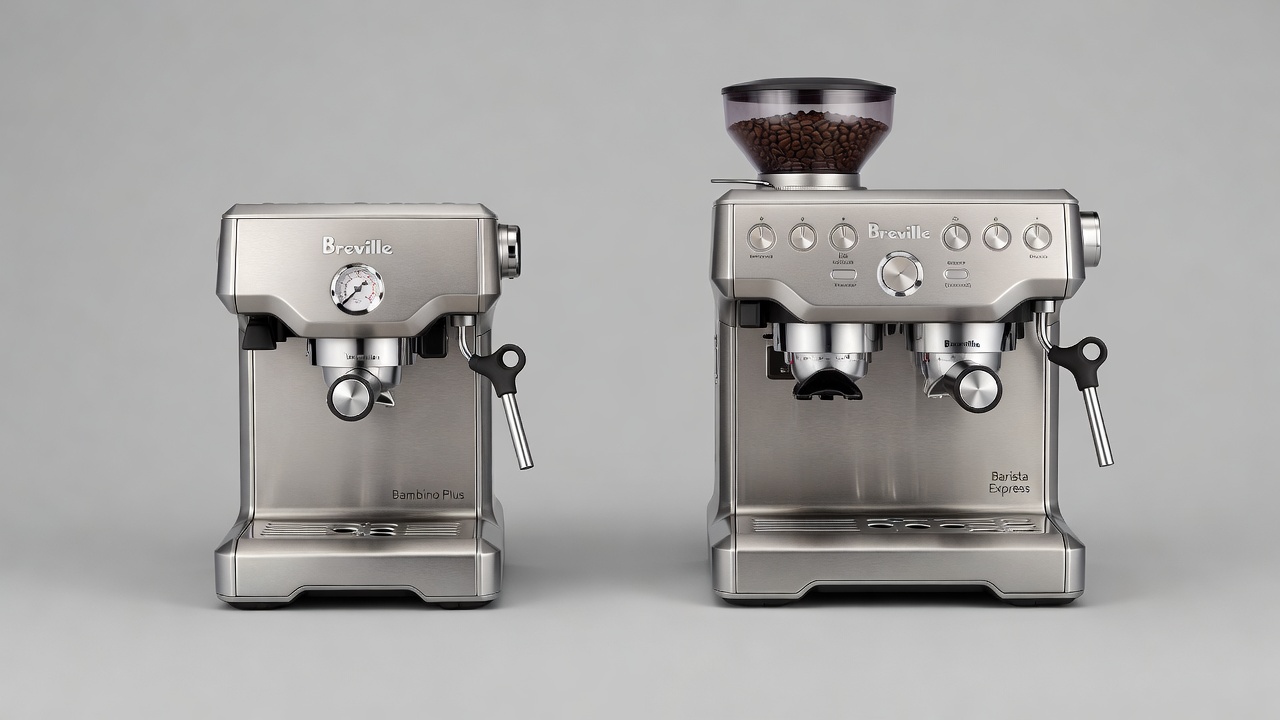
The Breville Bambino Plus and Barista Express sit at different ends of Breville's compact espresso lineup. The Bambino Plus is ultra-compact with no grinder - designed for counters where every inch counts. The Barista Express is an all-in-one machine with a built-in conical burr grinder. Both promise third-wave specialty coffee at home. Both claim to deliver consistent espresso without the bulk of prosumer machines.
But which one actually delivers better espresso? Does the Barista Express's built-in grinder match a separate setup? Does the Bambino Plus's smaller footprint compromise shot quality? This comparison breaks down the real differences based on specs, build quality, and daily use performance.
Specs Head-to-Head
| Spec | Bambino Plus | Barista Express |
|---|---|---|
| Dimensions | 7.7" W x 12.5" D x 12.2" H | 12.5" W x 13.2" D x 15.8" H |
| Weight | 11 lbs | 23 lbs |
| Boiler | Thermojet (3 sec heat-up) | Thermocoil (30 sec heat-up) |
| Pump Pressure | 15 bar (9 bar at brew head) | 15 bar (9 bar at brew head) |
| Grinder | None (requires separate grinder) | Built-in conical burr, 16 settings |
| Milk Frothing | Automatic microfoam system | Manual steam wand (slower) |
| Portafilter | 54mm stainless steel | 54mm stainless steel |
| Water Tank | 2L removable | 2L removable |
| Price (2026 avg) | $500 | $700 |
The Bambino Plus is 60% lighter and occupies half the counter footprint. The Barista Express trades size for an integrated grinder - the feature that justifies its higher price and bulk.
Size & Counter Space
The Bambino Plus is Breville's smallest espresso machine. At 7.7 inches wide, it fits in spaces where the Barista Express won't - under cabinets, in apartment kitchens, or next to other appliances. The Thermojet heating system eliminates the warm-up wait found on larger machines. Heat-up time is 3 seconds, not 30. That means you can pull a shot immediately after turning it on.
The Barista Express is a full-width machine designed to sit as a permanent countertop fixture. The built-in grinder adds width and weight. It's not a machine you tuck away after each use. At 23 pounds, moving it daily is impractical. If counter space is tight, the Bambino Plus wins by default.
But size isn't everything. The Barista Express's larger footprint comes with a grinder that handles dose, grind size, and tamping in one workflow. The Bambino Plus requires a separate grinder - which means a second appliance on the counter. A quality espresso grinder like the Baratza Encore ESP or Fellow Ode adds another 6-8 inches of counter width. Total footprint can end up similar if you're buying the Bambino Plus with a proper grinder.
Grind Quality & Consistency
The Barista Express's built-in conical burr grinder offers 16 grind settings. That sounds like flexibility, but the grind steps are too coarse for precise dialing in. The gap between setting 7 and setting 8 can be the difference between sour under-extraction and bitter over-extraction. There's no in-between.
The grinder also suffers from retention. Coffee grounds stick in the chute and burrs, mixing fresh grounds with stale remnants from previous doses. Retention can reach 2-3 grams per grind cycle - enough to affect dose accuracy and introduce staleness into your puck. Single-dosing (grinding only what you need for one shot) partially mitigates this, but the grinder isn't designed for it.
The Bambino Plus has no grinder, which forces you to invest in a separate unit. But that's an advantage for shot quality. A dedicated espresso grinder like the Baratza Sette 270 or Fellow Opus delivers finer grind steps, lower retention, and better particle distribution. Better grind quality translates directly to better extraction and more control over flavor.
If you already own a quality grinder, the Bambino Plus is the better value. If you're starting from zero and need an all-in-one solution, the Barista Express covers the basics - but expect to upgrade the grinder later if you care about dialing in precisely.
Shot Consistency & Espresso Quality
Both machines use 15-bar pumps de-rated to 9 bars at the brew head - the standard for espresso extraction. Both use 54mm portafilters and identical brew heads. Both heat water to the same target temperature range (195-205°F). On paper, shot quality should be identical.
In practice, grind quality is the limiting factor. The Barista Express's built-in grinder struggles with consistency. Shots vary more from day to day because grind particle size isn't uniform. Channeling - where water finds paths of least resistance through the puck instead of flowing evenly - happens more often. You'll see uneven extraction, weak crema, and flavor that doesn't match the beans' potential.
The Bambino Plus paired with a better grinder delivers more consistent shots. Grind uniformity reduces channeling. Extraction becomes predictable. You dial in once and shots stay dialed in for days, not hours. The machine itself isn't better at brewing - the grinder is better at preparing the puck.
Temperature stability is similar on both machines. The Bambino Plus's Thermojet system heats faster, but the Barista Express's Thermocoil maintains temp just as well once it's up to operating temperature. Neither machine has the dual-boiler temp control found on prosumer setups, but for $500-$700, they're both adequate.
Shot volume control is manual on both machines. You start the pump, watch the shot pull, and stop it when you hit your target yield (typically 1:2 ratio - 18g in, 36g out in 25-30 seconds). Neither machine has programmable shot buttons or flow profiling. If you want to pull a ristretto or lungo, you time it manually or use a scale under the portafilter.
Frothing & Milk Texture
The Bambino Plus's automatic milk frothing system is the machine's standout feature. You insert the steam wand into a pitcher, select temp and texture (latte or cappuccino foam), and press start. The machine froths to target temp and stops automatically. Microfoam quality is consistent - fine bubbles, glossy texture, suitable for latte art. No learning curve. No scorched milk from overheating.
The Barista Express uses a manual steam wand. You control the wand position, depth, and timing. Steam power is adequate but slower than the Bambino Plus's Thermojet-driven system. Heating 8 ounces of milk to 150°F takes 40-50 seconds on the Barista Express vs 25-30 seconds on the Bambino Plus. The wand produces good microfoam if you have the technique, but there's a learning curve. Beginners will scorch milk, create large bubbles, or under-froth.
If you're new to espresso and want reliable milk drinks without practice, the Bambino Plus's automatic system wins. If you want manual control over foam texture and don't mind learning steam wand technique, the Barista Express's manual wand is acceptable - but it's not faster or better than the Bambino Plus's system.
Real Use Case Winner
Choose the Bambino Plus if:
- You have limited counter space or want a machine you can move easily
- You already own a quality espresso grinder or plan to buy one separately
- You want fast heat-up time (3 seconds vs 30)
- You want automated milk frothing without the learning curve
- You're willing to invest in a separate grinder for better shot quality
Choose the Barista Express if:
- You want an all-in-one solution with built-in grinder
- You have permanent counter space for a larger machine
- You're okay with learning manual steam wand technique
- You don't want to research and buy a separate grinder
- You're starting from zero and need everything in one purchase
The Bambino Plus is the better espresso machine for shot quality - but only if you pair it with a grinder that costs $200-$400. Total investment approaches $700-$900. The Barista Express delivers everything in one $700 package, but you'll eventually want to upgrade the grinder if you care about dialing in precision.
For home baristas who already own a grinder, the Bambino Plus is the clear winner. For beginners who want one purchase and acceptable results immediately, the Barista Express makes sense. But understand that the built-in grinder is the weak link - not the espresso brewing capability.
Final Verdict
The Breville Bambino Plus wins on size, speed, and frothing convenience. The Barista Express wins on all-in-one simplicity. Shot quality depends entirely on the grinder - and the Barista Express's built-in unit is adequate but not excellent. If you're serious about espresso, pair the Bambino Plus with a quality grinder like the Baratza Sette 270 and skip the Barista Express entirely.
If you're new to espresso and want the convenience of beans-to-espresso in one machine, the Barista Express delivers acceptable shots without requiring a second purchase. Just know that when you're ready to dial in more precisely, you'll be looking at grinder upgrades.
For most home baristas who want the best espresso quality per dollar, the Bambino Plus paired with a separate grinder is the better long-term investment. Compact footprint, faster workflow, and better shot consistency when you control the grind.