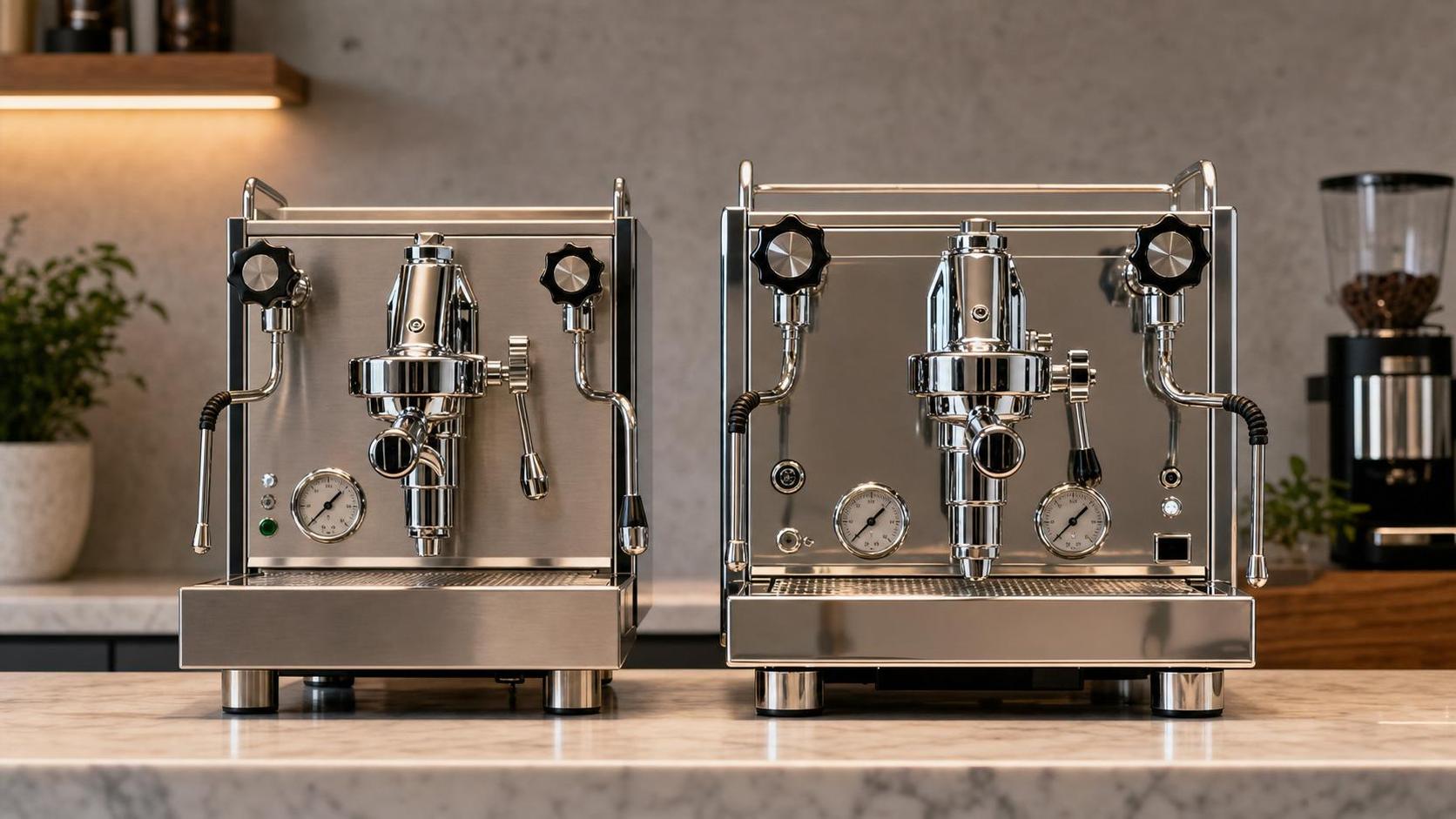
Profitec Pro 500 vs Rocket R58: Heat Exchanger Espresso Machine Showdown
The Profitec Pro 500 and Rocket R58 sit at opposite ends of the premium home espresso spectrum. One is a heat exchanger with PID refinement and Italian engineering discipline. The other is a dual boiler with touchscreen control and rotary pump flexibility. Both wear E61 group heads. Both carry reputations for long-term durability. Neither is cheap.
The price gap tells part of the story. The Pro 500 lists at $2099. The R58 sits at $3300 - a $1200 premium for the dual boiler architecture. That spread isn't just boiler count. It's rotary vs vibration pump, independent temperature control vs heat exchanger compromise, and Milan prestige vs German precision manufacturing.
This comparison strips away marketing and focuses on what matters: build quality, temperature stability, espresso consistency, steaming capability, and whether the price difference delivers $1200 worth of performance improvement in daily home use.
Affiliate Disclosure: EspressoSnob participates in the Amazon Services LLC Associates Program. We earn commissions from qualifying purchases through our Amazon links at no extra cost to you. We recommend products based on specifications, performance, and value, not commission rates.
Quick Picks: Which Machine Wins Where
| Category | Winner | Why |
|---|---|---|
| Best Temperature Stability | Rocket R58 | Dedicated brew boiler with PID holds ±1°F. No cooling flushes required even after 2-hour idle. |
| Best Value | Profitec Pro 500 | $2099 delivers E61 group, PID steam control, insulated boiler, and simultaneous brew/steam. No dual boiler premium. |
| Best Build Quality | Tie | Both use massive E61 groups, stainless/brass boilers, no-burn wands. Pro 500 has spring-loaded valves; R58 has rotary pump. |
| Best for Light Roasts | Rocket R58 | Direct brew boiler PID lets you set 204°F and hit it consistently. Pro 500 requires flush discipline and steam boiler offset math. |
| Best Steaming Endurance | Profitec Pro 500 | 2L steam boiler vs R58's 1.8L. Larger reservoir maintains pressure longer during back-to-back milk drinks. |
Bottom line: The R58 is the better espresso machine if temperature precision matters more than $1200. The Pro 500 is the better value if you understand heat exchanger workflow and want high-end components without dual boiler cost.
Specs Head-to-Head
| Specification | Profitec Pro 500 | Rocket R58 |
|---|---|---|
| Boiler Type | Heat Exchanger | Dual Boiler |
| Boiler Capacity | 2.0L steam (stainless steel) | 0.6L brew + 1.8L steam (copper/brass) |
| PID Control | Yes - steam boiler only | Dual PID - independent brew + steam |
| Pump Type | Vibration | Rotary |
| Brew Group | E61 - 4.5kg chrome-plated brass | E61 - chrome-plated brass |
| Water Source | 2.8L reservoir (tank only) | 2.5L reservoir or plumb-in |
| Pre-Infusion | Yes (passive E61 thermosyphon) | Yes (passive E61 thermosyphon) |
| Shot Timer | Yes (analog) | Yes (touchscreen digital) |
| Steam Wand | No-burn design, 2-hole tip | No-burn design, interchangeable tips |
| Dimensions (W×D×H) | 30.2 × 44.7 × 39.3 cm | 31.0 × 44.0 × 38.5 cm |
| Weight | 23.5 kg | 29 kg |
| Power | 1400W (230V) | 1600W (220-240V / 115V) |
| MSRP | $2099 | $3300 |
The spec table makes the architectural divide clear. The Pro 500 is a refined heat exchanger with modern PID control grafted onto a proven single-boiler thermosyphon design. The R58 is a ground-up dual boiler with independent temperature domains and the infrastructure (rotary pump, plumb-in capability) to support commercial-style workflow at home.
Build Quality Assessment
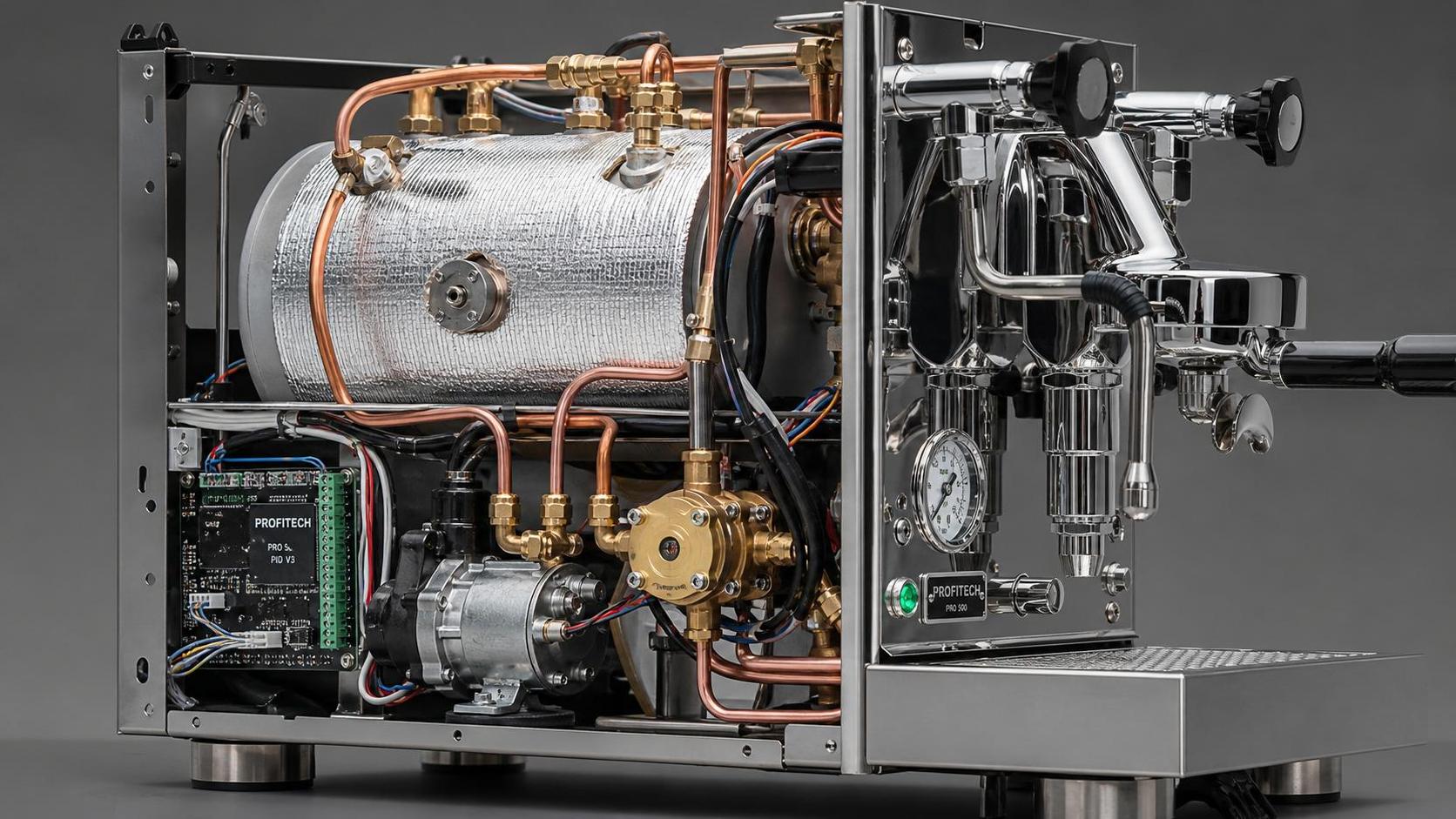
Both machines use the same E61 brew group - a 4.5kg thermosyphon design that's been the espresso industry standard since 1961. Chrome-plated brass construction. Passive pre-infusion through a spring-loaded valve. Continuous hot water circulation maintains group temperature without active heating.
The Pro 500's boiler is 2 liters of 304 stainless steel with full insulation. The R58 uses separate copper/brass boilers - 0.6L for brew, 1.8L for steam. Copper conducts heat faster than stainless but corrodes more easily in hard water without proper filtration. Profitec's stainless boiler tolerates water quality neglect better long-term.
Pump choice separates the two. The Pro 500's vibration pump is quieter than older vibratory designs but still audible during extraction. The R58's rotary pump runs nearly silent and delivers smoother pressure ramps - important for pressure profiling if you add flow control later. Rotary pumps also last longer under heavy use (8+ shots daily) but cost more to replace when they eventually fail.
Valve design favors the Pro 500. Spring-loaded rotary valves eliminate overwinding risk - you can't strip the threads or break the valve seat by turning too hard. The R58 uses standard lever-actuated valves. Durable, but not wear-proof.
Both machines use no-burn steam wands where only the tip gets hot. Milk doesn't bake onto cool stainless, making cleanup easier. The R58 includes interchangeable steam tips (1.5mm and 1.2mm) for different milk volumes. The Pro 500 ships with a fixed 2-hole tip.
Build quality winner: Tie. The Pro 500's stainless boiler and spring-loaded valves offset the R58's rotary pump and dual boiler complexity. Both are legitimate 10+ year machines if maintained properly.
Temperature Stability: Where Dual Boiler Dominates
This is where the $1200 price gap shows up in the cup.
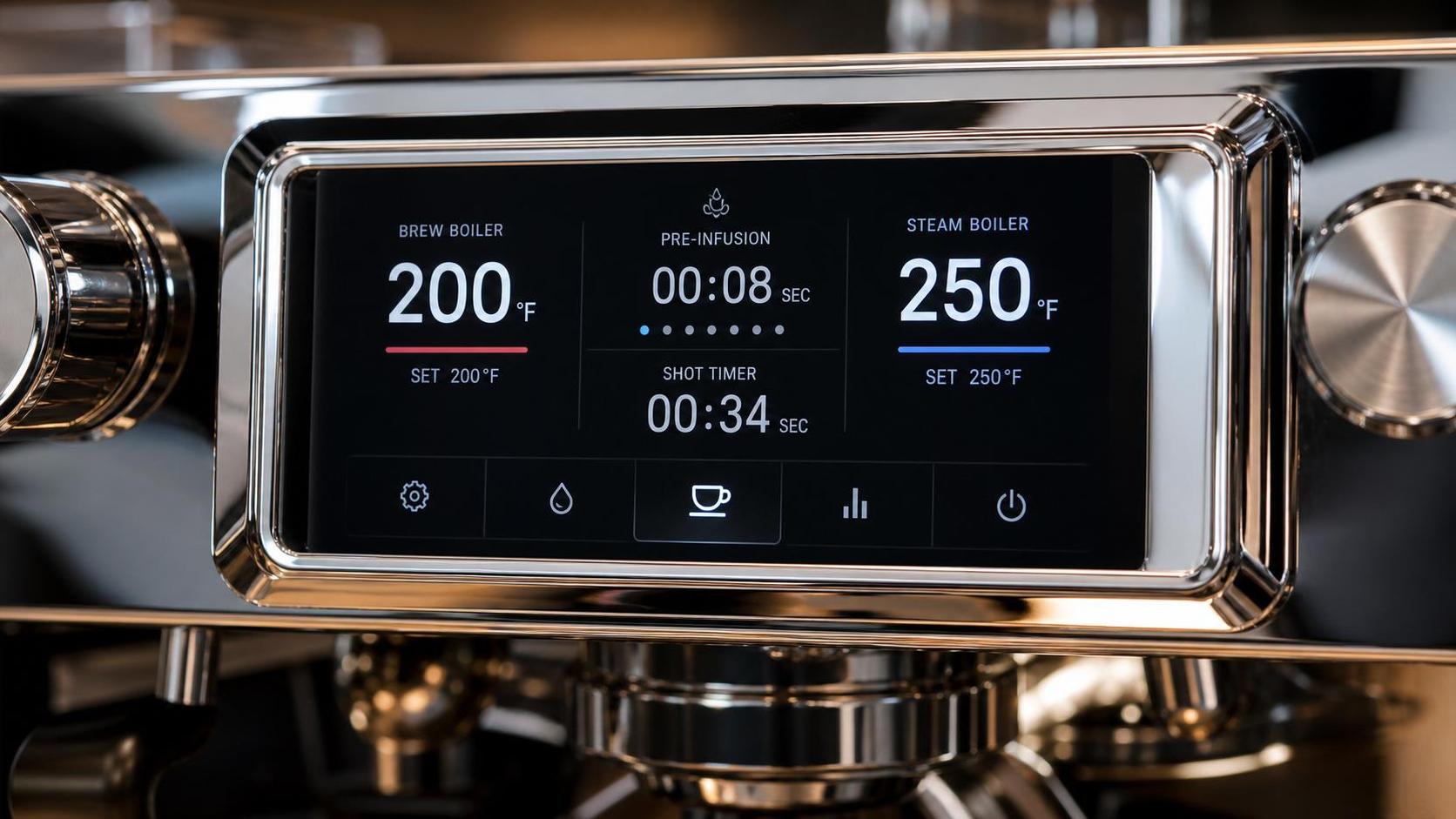
The Rocket R58's brew boiler holds 0.6 liters at your target temperature - 200°F for medium roasts, 204°F for light roasts, 197°F for dark. The PID controls this boiler directly. Set it and forget it. No cooling flushes. No temperature surfing. No steam boiler interaction. Independent thermal domain.
The Profitec Pro 500's PID controls the steam boiler, not brew temperature. Brew water enters the machine cold from the 2.8L reservoir, passes through a copper tube inside the steam boiler, and exits at whatever temperature the heat exchanger delivers. That temperature depends on three variables:
- Steam boiler temp (adjustable via PID)
- Flow rate (faster flow = cooler brew water)
- Idle time (longer idle = hotter heat exchanger)
If the machine sits idle for 30+ minutes, the heat exchanger tube soaks in 250°F+ steam boiler water and superheats. First shot pulls at 210°F+ unless you purge the group with a 3-5 second cooling flush. After the flush, brew temp stabilizes around 200-202°F for medium roasts.
The Pro 500's PID helps - you can lower steam boiler temp to reduce heat exchanger soak temperature - but it's still indirect control. You're adjusting an offset, not the brew temp itself. Reddit and Home-Barista forums report real-world Pro 500 brew temps ranging from 197°F to 208°F depending on workflow discipline.
The R58 measures ±1°F from target once warmed up. Set 200°F, get 200°F, shot after shot, whether you just steamed milk or the machine sat idle for two hours.
Temperature stability winner: Rocket R58. Not close. If you chase light roast extractions or want zero-thought temperature consistency, the dual boiler architecture is worth the premium.
Espresso Quality: Does the Brew Boiler Matter?
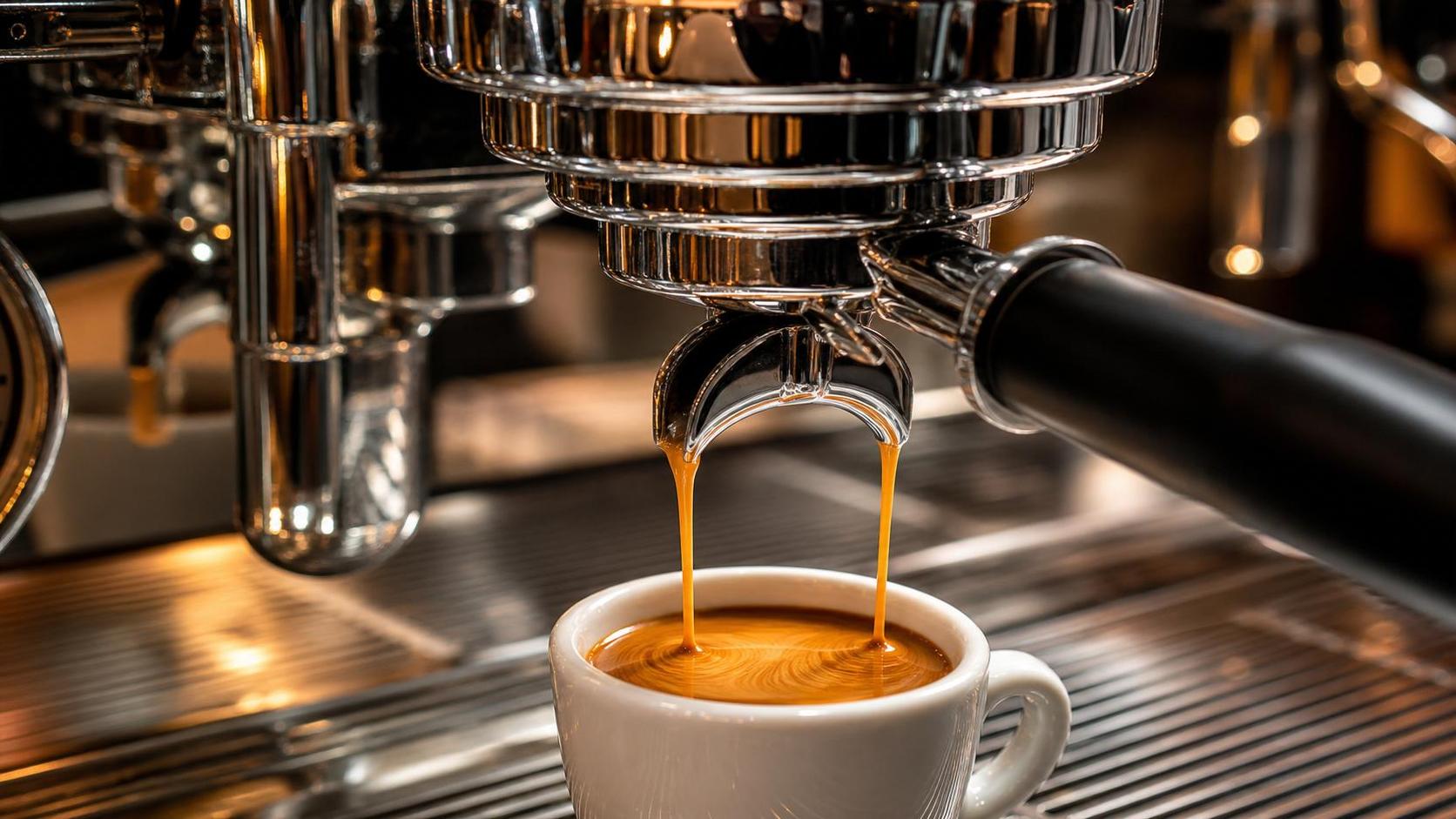
Both machines use identical E61 groups pulling through 58mm baskets. Same passive pre-infusion. Same 9-bar pump pressure (adjustable via OPV). Same portafilter compatibility. The hardware pulling the shot is functionally identical.
The difference is what feeds that hardware.
For medium roasts in the 200-202°F range, the Pro 500 delivers espresso quality indistinguishable from the R58 if you manage cooling flushes. Dial in your grind, flush the group after idle periods, and both machines produce the same clarity, body, and extraction yield.
For light roasts requiring 204-205°F, the R58 pulls ahead. You can set the brew boiler to 204°F and hit it every shot. The Pro 500 requires steam boiler adjustments, shorter flushes, and shot-to-shot monitoring to stay in range. Possible, but higher cognitive load.
For back-to-back shots (entertaining, making multiple drinks), the Pro 500's 2L steam boiler maintains pressure better than the R58's 1.8L. Steaming 12oz of milk drops steam pressure temporarily on both machines, but the Pro 500 recovers faster due to larger thermal mass. The R58's smaller brew boiler means less thermal inertia during rapid shot sequences, but the dedicated PID compensates by reheating precisely to target.
Espresso quality winner: Rocket R58 for light roasts and set-it-forget-it consistency. Profitec Pro 500 matches it for medium/dark roasts if you stay disciplined with flush workflow.
Steaming Power and Workflow
Both machines steam and brew simultaneously. Heat exchanger and dual boiler architectures both support concurrent operation - you're never waiting for a boiler to switch modes.
The Pro 500's 2L steam boiler produces slightly more sustained steam pressure during long steaming sessions (16oz+ milk pitchers, back-to-back cappuccinos). Larger thermal mass = slower pressure drop under load.
The R58's 1.8L steam boiler recovers faster after steaming because the PID actively manages temperature. Steam pressure drops during a 12oz steam, then the heating element fires and brings the boiler back to target within 60-90 seconds. The Pro 500's larger boiler takes longer to reheat but needed less recovery in the first place.
Real-world difference: negligible for home use (1-4 drinks per session). The Pro 500 edges ahead if you're making 6+ milk drinks in a row. The R58's faster recovery matters if you're alternating between espresso and milk drinks rapidly.
The R58's no-burn wand with interchangeable tips (1.5mm and 1.2mm) gives more flexibility. Use the 1.5mm tip for 12-16oz pitchers, swap to 1.2mm for single 6oz cappuccinos. The Pro 500's fixed 2-hole tip works for everything but lacks that tunability.
Steaming winner: Tie with slight edge to Pro 500 for sustained output, slight edge to R58 for faster recovery and tip flexibility.
Price and Value Analysis
The Profitec Pro 500 lists at $2099. The Rocket R58 at $3300. That's a 57% price premium for dual boilers.
What does $1200 buy you?
- Rotary pump (quieter, smoother pressure, plumb-in capable, longer lifespan under heavy use)
- Dual boilers (independent brew + steam temperature domains, no heat exchanger flush discipline required)
- Direct brew temperature control (PID sets actual brew temp, not steam boiler offset)
- Touchscreen interface (digital shot timer, programmable auto-on, cleaner aesthetic with removable pod)
- Plumb-in capability (direct water line connection for offices or high-volume home use)
What does the Pro 500's $2099 deliver that cheaper heat exchangers don't?
- PID control (steam boiler temperature regulation - cheaper HX machines like the Rocket Appartamento lack this)
- Insulated stainless steel boiler (better energy efficiency, more corrosion resistance than bare copper)
- Spring-loaded rotary valves (wear-free, impossible to overwind)
- Larger boiler (2L vs 1.5L on most competitor HX machines - more steaming endurance)
- German build quality (Profitec's parent company ECM has 20+ years of E61 manufacturing refinement)
The Pro 500 sits in a narrow value band: premium heat exchanger without dual boiler cost. If you're upgrading from a Gaggia Classic or Breville Barista Express, the Pro 500 delivers a massive jump in build quality and steaming capability for $2099. The R58 delivers a smaller incremental improvement over the Pro 500 for another $1200.
If you're comparing the Pro 500 against other heat exchangers (Rocket Appartamento at $1849, ECM Casa V at $1899), the Pro 500's PID and insulated boiler justify the premium. If you're comparing the R58 against other dual boilers (ECM Synchronika at $3799, Lelit Bianca at $2999), the R58's rotary pump and Rocket build quality compete well.
Value winner: Profitec Pro 500 if you're stepping up from entry machines and understand HX workflow. Rocket R58 if temperature precision and set-it-forget-it operation justify the premium.
Long-Term Ownership and Maintenance
Both machines require regular descaling. Use Urnex Dezcal every 2-3 months depending on water hardness. The Pro 500's stainless boiler tolerates harder water better than the R58's copper/brass boilers, but both benefit from filtered water or a softening system.
The R58's rotary pump is a wear item. Expect 5-10 years under normal home use (2-4 shots daily). Replacement cost: $200-300 parts + labor. The Pro 500's vibration pump is cheaper to replace ($80-120) but may need replacement sooner (3-7 years under similar use).
E61 group gaskets need replacement every 12-18 months regardless of machine. Same part, same wear pattern, same $15 cost.
The Pro 500's spring-loaded valves are genuinely wear-free - the springs absorb overtightening force that would strip threads on standard valves. The R58's lever valves are durable but not indestructible. Handle with care.
Both machines ship with basic maintenance kits. Invest in a quality 58mm calibrated tamper (the included plastic tampers are toys) and consider a spring-loaded tamper with click feedback for consistent puck prep across both machines.
Maintenance winner: Tie. The Pro 500's stainless boiler and cheaper pump replacement offset the R58's longer-lasting rotary pump.
Who Should Buy Which
Buy the Profitec Pro 500 if:
- You're upgrading from a Gaggia Classic, Breville Barista Express, or similar entry machine and want legitimate long-term build quality without dual boiler cost
- You primarily drink medium to dark roasts in the 198-202°F range where heat exchanger temperature variance doesn't affect extraction
- You're willing to learn cooling flush discipline (3-5 second purge after 30+ minute idle)
- You make 4-6 milk drinks in a row regularly and value the larger 2L steam boiler's endurance
- $2099 is your ceiling and you want the best heat exchanger at that price
Buy the Rocket R58 if:
- You chase light roast extractions requiring 204-205°F and need shot-to-shot temperature precision
- You want set-it-forget-it operation with no cooling flushes or temperature surfing
- You value the rotary pump's quieter operation and smoother pressure delivery
- You plan to plumb the machine into a water line (office, high-volume home use)
- The touchscreen interface and programmable features appeal to you
- You're comparing dual boilers and the R58's build quality and aesthetics justify the premium over alternatives like the ECM Synchronika
The 2026 Verdict
The Profitec Pro 500 is the better value. $2099 buys you an E61 machine with PID control, insulated stainless boiler, wear-free valves, and simultaneous brew/steam capability that will last 10+ years. It's a heat exchanger, which means you pay attention to cooling flushes and accept some temperature variance. That's the trade for saving $1200.
The Rocket R58 is the better espresso machine. Dual boilers eliminate heat exchanger compromise. Rotary pump runs quieter and lasts longer. Direct brew temperature control means you set 200°F and get 200°F every shot. The $1200 premium buys workflow simplicity and temperature precision that matters if you chase light roast extractions or want zero-thought consistency.
Neither machine is a "budget" option. Both sit in the premium home espresso category where build quality, component choice, and long-term durability justify the investment. The question isn't whether these machines are worth it compared to $800 entry machines - they are. The question is whether the R58's dual boiler refinement is worth $1200 over the Pro 500's heat exchanger discipline.
For most home users making 2-4 drinks daily with medium roasts, the Pro 500 delivers 95% of the R58's performance at 64% of the cost. For light roast enthusiasts, high-volume households, or users who value set-it-forget-it simplicity above saving $1200, the R58's dual boilers are the right choice.
Both machines make excellent espresso. The Pro 500 makes you work slightly harder for it. The R58 makes it easier to get there consistently. Choose based on workflow preference, roast style, and whether $1200 buys you peace of mind or just boiler count.
Frequently Asked Questions
Is the Profitec Pro 500 a heat exchanger or dual boiler?
The Profitec Pro 500 is a heat exchanger machine. It has one 2-liter stainless steel steam boiler with a copper heat exchanger tube running through it. Brew water passes through the tube, heating to espresso temperature without mixing with steam boiler water. The R58 is a true dual boiler with separate 0.6L brew and 1.8L steam boilers.
Does the Rocket R58 require cooling flushes?
The Rocket R58 does not require cooling flushes. As a dual boiler machine with independent PID control on each boiler, brew temperature stays stable regardless of how long the machine sits idle. The Pro 500 heat exchanger can overheat during extended idle periods, requiring a short flush to purge superheated water before pulling shots.
Can you steam and brew at the same time on the Profitec Pro 500?
Yes. The Profitec Pro 500 heat exchanger design allows simultaneous brewing and steaming. The steam boiler maintains constant pressure while the heat exchanger supplies fresh brew-temperature water. Both machines support simultaneous brew/steam, but the R58's dual boilers eliminate temperature compromise - each boiler stays at its target temp regardless of what the other is doing.
Which machine has better temperature stability: Pro 500 or R58?
The Rocket R58 has superior temperature stability. Its dedicated 0.6L brew boiler with PID holds steady to within 1 degree F once dialed in. The Pro 500's heat exchanger temperature varies with steam boiler temp, idle time, and recent water draw. PID on the Pro 500 controls steam boiler temp, not brew temp directly. Real-world Pro 500 brew temp can swing 5-8°F without cooling flushes.
Is the Profitec Pro 500 worth it compared to cheaper heat exchangers?
Yes, if build quality matters. The Pro 500 uses a 2L insulated stainless steel boiler, wear-free spring-loaded rotary valves, and no-burn steam wands. Cheaper HX machines like the Rocket Appartamento lack PID and boiler insulation. The Pro 500 sits between entry HX machines ($1400-1700) and dual boilers ($2800+). At $2099 MSRP it's a premium heat exchanger, not a budget dual boiler alternative.
Can the Rocket R58 be plumbed into a water line?
Yes. The R58's rotary pump supports both reservoir operation (2.5L tank) and direct plumb-in to a household water line via a quick-connect fitting. The Pro 500 is reservoir-only - no plumb-in option due to vibration pump design.
How long does the Profitec Pro 500 take to heat up?
15-25 minutes from cold start to stable brew temperature. The R58 is similar (15-30 minutes) despite having two boilers because the brew boiler is smaller and heats faster. Both machines benefit from programmable timers or smart plugs to pre-heat before morning use.
Do both machines use the same portafilter size?
Yes. Both use standard 58mm portafilters and E61 group gaskets. Aftermarket bottomless portafilters, precision baskets, and group head accessories are universally compatible. This is a major advantage over proprietary portafilter systems on cheaper machines.
Which machine is quieter during operation?
The Rocket R58. Rotary pumps run nearly silent - you hear water flowing and the group head hissing during extraction, but no pump vibration. The Pro 500's vibration pump is audible during shots (similar volume to a Gaggia Classic Pro). Not loud, but noticeably louder than the R58's rotary pump.
Can you add flow control to either machine?
Yes, both support aftermarket flow control devices that replace the stock E61 group mushroom. Popular options include the Lelit needle valve or E61 flow control kit. Installation requires some mechanical skill but is reversible. Flow control lets you manually adjust brew pressure during extraction for pressure profiling.
Related: Gaggia Classic Pro vs Rancilio Silvia | Best Espresso Grinder Under $300 | Niche Zero vs Baratza Sette 270 | Rocket R58 Full Review
Affiliate Disclosure: EspressoSnob participates in the Amazon Services LLC Associates Program, an affiliate advertising program designed to provide a means for sites to earn commissions by linking to Amazon.com. We earn commissions from qualifying purchases made through our Amazon links at no additional cost to you. These commissions support our research, testing, and content creation. We recommend products based on specifications, performance, and value, not commission rates.
Photos provided by Pexels.